
The Astea way of mixing innovation, creative solutions, and expertise in its work with Broadcastr
They say to know where you’re going, you have to remember where you started. As Astea turns 20, we’re embarking on a retrospective journey to the roots of our most ambitious endeavors. Past projects, initiatives, and technical achievements represent the core of Astea’s legacy and provide an inspiring insight into the expertise, dedication, and creative solutions that have driven our company forward since its inception.
Innovation – in the rise of digitization
Roughly fifteen years ago, during a period of rapid technological advancement, the challenge of migrating traditional media into the digital realm was a particularly exciting one. This era coincided with the launch of 3G internet in the U.S. and Europe, alongside the debut of the iPhone, Android phones, and second-generation tablets, truly making information and content instantly accessible.
Broadcastr chose Astea as its reliable partner for digitizing audio content, leveraging Astea’s established expertise in publishing. The product’s unique offering was to link audio narratives to specific real-world geographical locations. It was designed to offer listeners immersive, contextual stories – often told by residents – about their favorite places, historical sites, or points of interest.
Expertise – building a pioneering geospatial audio storytelling platform
The foundation of Broadcastr rested on its ability to visually present stories on a map. It relied on user-generated content, encouraging the public to record and upload their own audio narratives. Stories were discoverable via a map interface, making exploration intuitive. Users could search for content by topic, keyword, or specific address. The platform allowed personalisation by saving stories as “favorites” for later listening.
Broadcastr was one of the first applications of its kind designed for a simultaneous, unified release across three distinct environments: the web, iOS, and Android mobile. This cross-platform development required sophisticated management of codebases and a consistent user experience across disparate operating systems and screen sizes.
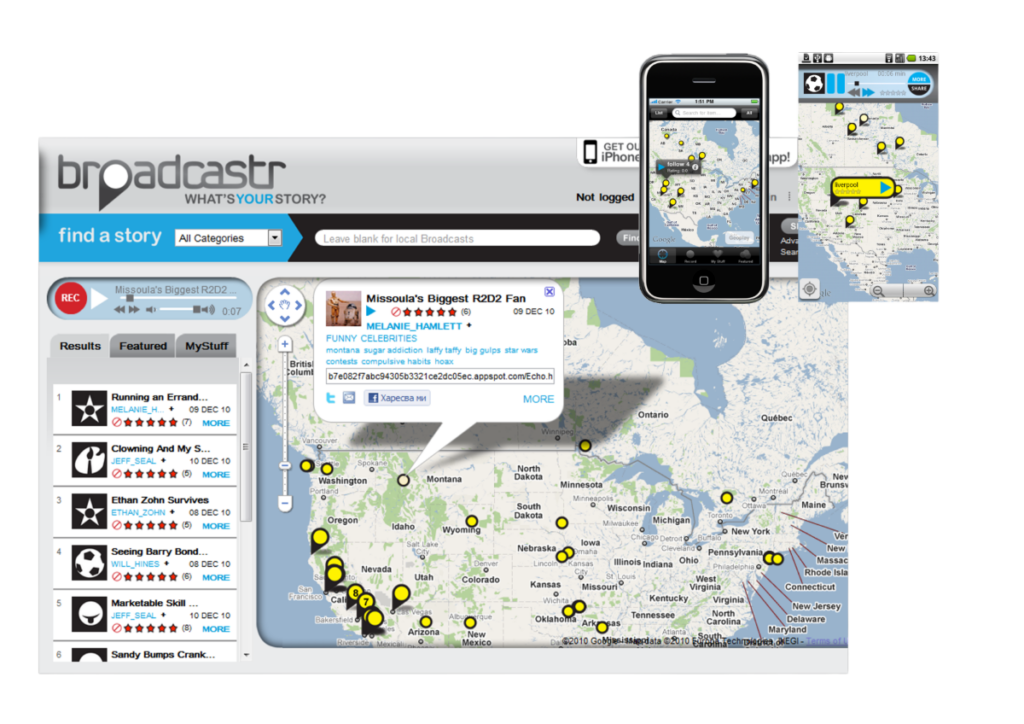
The Astea team faced more than new technology and devices – the Аsteans had to overcome significant challenges at the time. For example, when hundreds or even thousands of stories were tied to a single, dense location (like a major landmark), simply placing them all on the same GPS coordinate would render the map unusable. This required an algorithm to visually arrange this massive quantity of potential story points evenly and intelligibly on the map, a problem compounded by the fact that mature map products like Google Maps and Foursquare were themselves just beginning to emerge.
Developing a fair and accurate content rating system was also complex. It had to balance two critical factors: the raw count of people who had rated a story (quantity of interaction) against the numerical value of the individual ratings (quality of opinion). A further challenge was developing a clear, intuitive way to visualize the combination of both the story’s geographical location and its aggregated rating data for the user.
Creative solutions – the Astea way
One of the most entertaining and creative solutions emerged from troubleshooting a persistent, difficult-to-reproduce bug related to poor audio quality. The issue was eventually traced not to the application code itself, but to the poor quality of the 3G network when a user was moving rapidly near large metal structures, such as walking between city skyscrapers. The signal disruption caused the audio interruptions.
To reliably simulate this erratic, low-quality internet connection for testing, debugging, and validating fixes, the Astea team devised the unconventional “Trash can” test. They used a large, metal trash can – which acted effectively as a makeshift Faraday cage – to strategically disrupt the phone’s signal, replicating the real-world conditions of urban interference. This pragmatic, outside-the-box solution allowed them to stabilize the app’s performance under marginal network conditions.
In addition, to ensure scalability and handle a potentially large global user base, the team became early and aggressive adopters of cloud technologies. They built the application using Google App Engine, with application servers and databases hosted on Google’s infrastructure. This reliance on cloud-native solutions was a significant novelty at the time, positioning Astea as a leader in emerging cloud development practices.
Continuity – important business lessons
It would have been smooth sailing, but a major insight was emerging on the horizon. Users often disliked the sound of their own recorded voices. This led to failure in the user validation of the product since people were reluctant to share what they perceived as low-quality or imperfect personal recordings. Recognizing this fundamental barrier, Broadcastr executed a strategic pivot away from user-generated toward professionally-generated content, forming partnerships with museums and historical organizations.
A landmark partnership involved the 9/11 Memorial & Museum, where Broadcastr provided a special, dedicated experience on the occasion of the museum’s opening for the 10th anniversary of the attacks. This included the deployment of tablet-equipped kiosks at the site, which played moving stories from eyewitnesses, survivors, and rescuers, transforming the physical location into a living audio archive of oral histories.