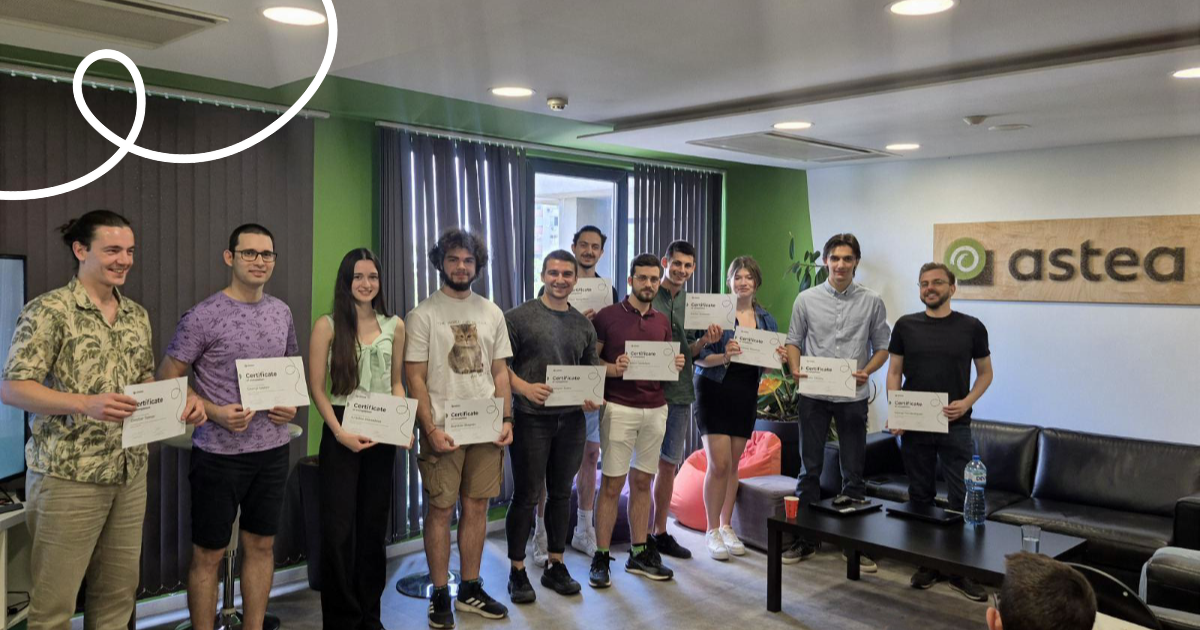

To celebrate our 11-year partnership with Hack TUES, we sit down with Alexander Yordanov from Astea, whose connection to the annual hackathon is both deep and multifaceted.
Alexander’s unique experience spans the entire spectrum of the event – beginning as an eager, innovative participant, transitioning into a tech professional, and ultimately returning to serve as a valued mentor. His journey is a powerful testament to the impact and developmental potential of Hack TUES.
In this conversation, Alexander shares his invaluable insights on the powerful role of mentorship in shaping the next generation of IT professionals.
Last year was your first time as a mentor, right? What surprised you the most about being the one sharing the knowledge? On the other hand, did you learn something new from the students?
Last year was my first time mentoring at HackTUES as an official mentor from Astea – I had also mentored there the year before on my own. I worked with a team of five 12th-grade students, and I was surprised by how seriously they approached the hackathon. They had already organized their work, so what surprised me was how much one small tip could change everything. I just pointed them in a better direction, and they immediately ran with it to build something way better. It felt great to see how much of an impact a little guidance can have.
On the other hand, I learned that mentoring is really about how you talk to people. Even if you know the tech inside out, explaining it simply to someone else takes a whole new level of clarity and patience.
HackTUES has always been full of adrenaline. How do you keep the team spirit up when “the code isn’t working” and the deadline is coming up? Do you have a special “Astea approach” for these moments?
My first rule is simple: Don’t panic. When something goes wrong and time is running out, I help the team stay calm and break the problem into small, manageable steps. If we’re short on time, we change direction. I’d rather see us build a working MVP than go after a perfect feature that might fail.
To me, the Astea approach is about staying human and communicating with each other. We keep the vibe light with a bit of humor and quick brainstorming. I always remind them that HackTUES and all the hackathons like this are about the experience and learning, not just a flawless demo.
You’ve already been through the “full circle” (participant → professional → mentor). If you had to describe Astea’s atmosphere to a young person who is just graduating from TUES, what would you say?
If I had to break down the Astea atmosphere for someone graduating from TUES, I’d say it’s basically a calm, welcoming space full of colorful people – the kind of folks who have actual hobbies and interests outside of just grinding code or breaking software.
It’s definitely not your typical stiff corporate office. You can pretty much walk up to anyone with a question, and if they don’t have the answer, they’ll genuinely try to help you find the person who does instead of just brushing you off.
Is there something you’re hoping to see at this year’s hackathon? What do you want the students to get out of their meeting with you and Astea?
I hope to see more AI-free innovation this year. Even though using AI is popular right now, it’s good to remember that great engineering and fun projects were around long before everything had to be smart or automated.
I want students to feel comfortable asking any questions they have and to see that they can have honest conversations with people from the industry.
Mentorship is undeniably impactful – even a little guidance can really change the path of a student team. Here at Astea, we’re all about sharing knowledge and working together to get things done, and we are super proud of Аsteans like Alexander who share their know-how with the next generation of IT professionals. We’re really looking forward to Hack TUES 12, where we’ll get to meet loads of young people who are keen to develop their skills and bring their innovative ideas to life.